
Walled Off: The Hidden Cost of Gated Communities in South Africa
South Africa is walling itself in. Street by street, public roads are being sealed behind booms, biometric scanners, and razor wire. For many residents, it feels like the only rational response to a crime crisis. But the research tells a more troubling story: one about who pays the real price for these walls, and whether they even work.
The Case of Melville in Johannesburg
Melville is one of Johannesburg's most beloved suburbs: bohemian, multiracial, and famous for its open, walkable character. It sits alongside Auckland Park, home to the SABC and the University of Johannesburg. Together they form one of the city's last genuinely porous urban villages.
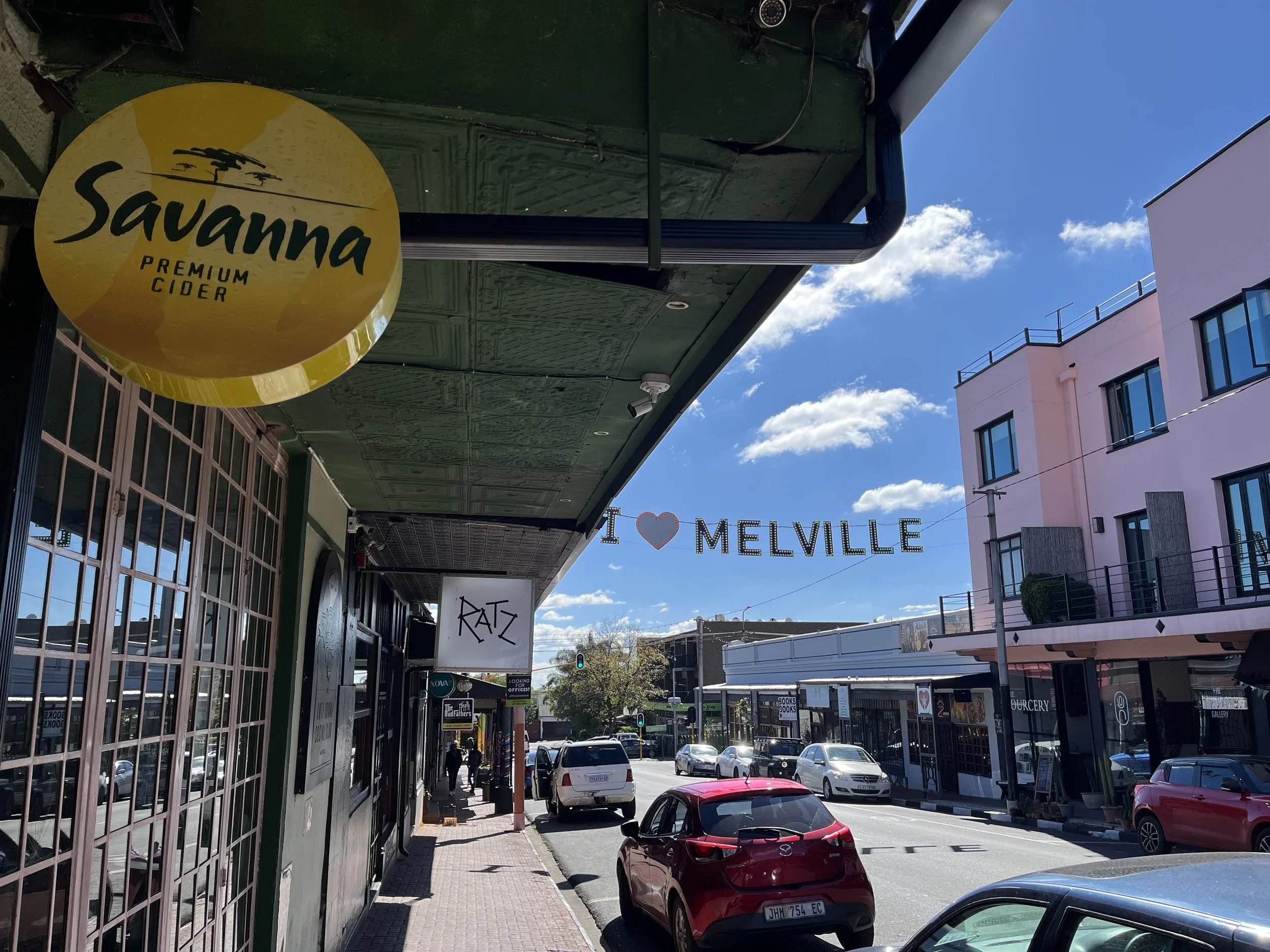
7th Street in Melville. (Image credit: LittleT889, Wikipedia, 2026. CC-BY 4.0.)
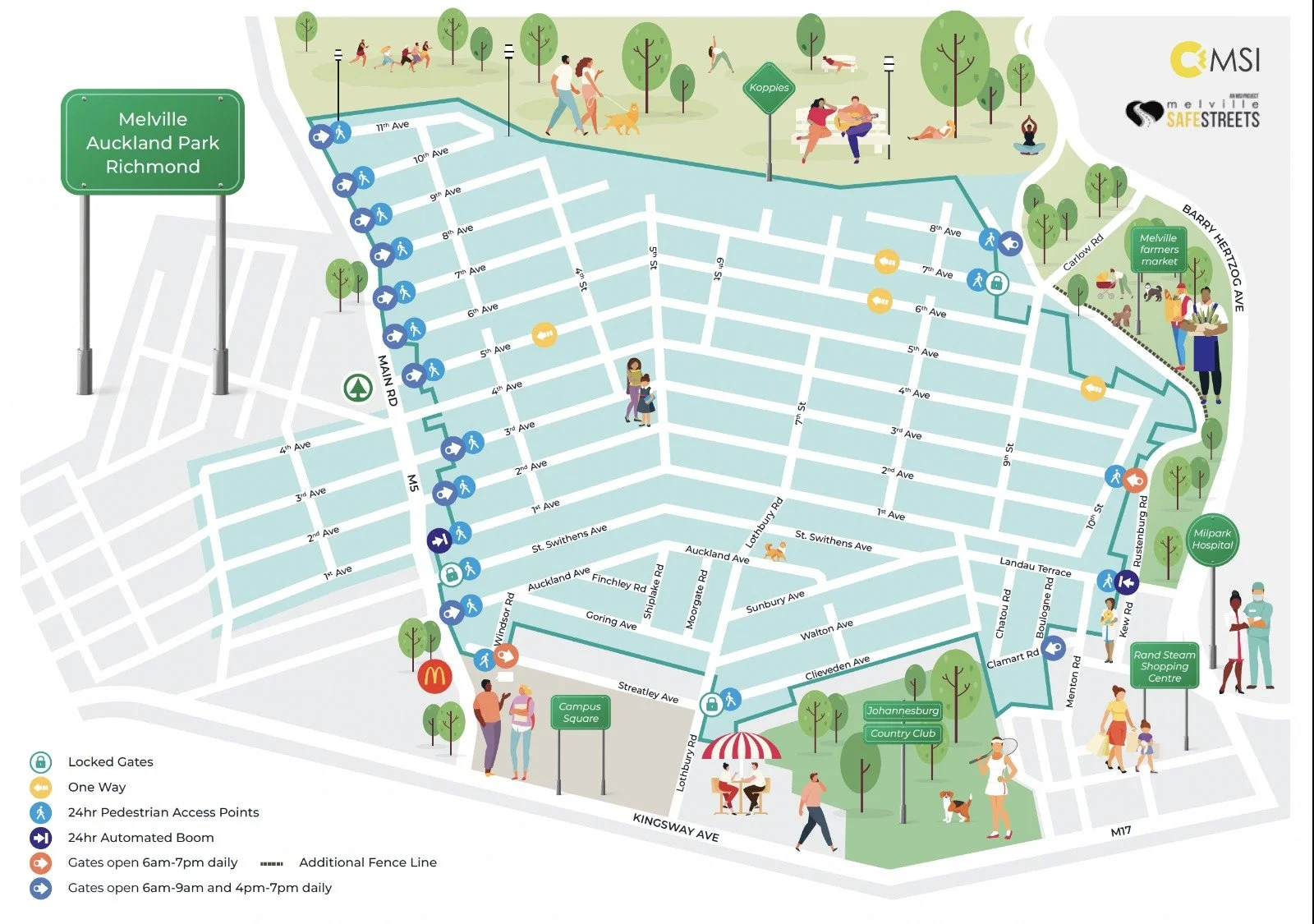
That is now under threat. The Melville Security Initiative (MSI), backed by the Melville Residents' Association (MRA), has proposed permanently closing or booming off numerous intersections, effectively creating a gated enclave. The original plan targeted 21 to 22 intersections. The Johannesburg Roads Agency (JRA) rejected it, ruling that four main entrances must remain open 24/7 and that pedestrian gates cannot be locked at any time.[1]
Even scaled back, the plan has drawn fierce opposition from neighbouring suburbs. Westdene, whose residents filed a formal petition arguing that "the least-privileged members of our society will be forced to pay the true cost of the proposed road closures," particularly pedestrians like domestic workers, students, and labourers who depend on walking through Melville daily.[2]
The South African Human Rights Commission (SAHRC) has been explicit on the broader issue: "These measures cause social division, dysfunctional cities and lead to the further polarisation of our society… the proposed benefits they bring by way of enhanced safety and security are in doubt and the subject of considerable debate."[3]
A National Pattern With Deep Roots
South Africa's gating instinct has been building since 1994. Jürgens and Gnad (2002) traced how fear of crime after apartheid's collapse drove the creation of private security enclaves across Johannesburg, where developments became defined by their safety measures and their population structure combined social and racial segregation.[4]
A systematic review of gated communities in African cities confirmed that such developments promote spatial fragmentation, privatise public space and local governance and propagate socio-economic inequality and urban segregation.[5] Ramoroka (2014) argues that gated planning perpetuates the spatial legacies of apartheid, offering security as a private market commodity rather than a public good.[6] The result is a two-tier city: private safety for the affluent, compounding exposure for the poor.
As Vincent Shibambo observed in a 2025 analysis: "Gated communities are a symptom. The disease is inequality."[7]
#/media/File:7th_Street_(Johannesburg).jpg)
Proposed road closures in Melville and Auckland Park (MRA meeting minutes March 2026)
Five Problems the Research Has Identified
1. Crime displacement, not crime reduction. Gating moves crime rather than eliminating it. The "funnel effect" raised at Melville's March 2026 meeting — that closing most streets pushes crime onto the ones that stay open — is well documented in South African research.[8] The SAHRC noted that security access restrictions did not exist prior to 1994, despite the prevalence of crime, raising questions about whether gating is a genuine safety solution or a comfort measure driven by fear.[3] Practically, armed response vehicles can also get stuck at closed gates while pursuing suspects on foot, undermining the security they are meant to support.[1]
2. Social fragmentation. The privatisation of public roads erodes social networks and deepens the distance between income groups.[4] Melville's multicultural, walkable character is inseparable from its openness. As the Westdene petition warned: "Melville has long been an important cultural hub for Johannesburg, famous for its multiculturalism, multiracialism and also its creative and inclusive atmosphere."[2] Gates do not just close roads. They close relationships.
3. Unequal security. Research has identified a marked shift toward private security in wealthier urban areas, leaving poorer neighbourhoods underpoliced despite rising risks, creating what researchers describe as "protection inequalities."[6] Walling off Melville does not create more safety in the world. It privatises safety for those who can afford it.
4. The apartheid echo. Lemanski (2004) showed how post-apartheid fortification perpetuated apartheid-era social divisions, arguing that "this trend in South Africa perpetuates the social divisions that were inherent in the apartheid state."[9] Ballard described gated communities as enabling "the privatisation of apartheid in democratic South Africa."[10] Johannesburg's 2019 inclusionary housing policy for new developments does not touch the vast number already built.[11]
5. Functional costs. The Westdene petition flagged restricted access to Milpark Hospital and local schools.[2] The SAHRC found that emergency services, water, electricity, and refuse trucks "find it problematic to enter and exit such enclosures."[3] At least 500 illegal road closures are believed to exist in Johannesburg alone, a sign of how far private action has outrun democratic accountability.[9]
The Deeper Problem
Gating is a retreat from the idea of a shared city. It reflects a breakdown of trust in public institutions, and it does nothing to address the underlying causes: inequality, unemployment, and inadequate policing.
The alternatives are well established: community-based patrolling, environmental design that improves natural surveillance, and investment in economic inclusion.[8] The Westdene residents put it plainly: focus security on the streets where crime concentrates, and build a longer table rather than a higher wall.[2]
When we gate a suburb, we are making a choice about who belongs in our city. We are saying safety is a commodity, not a right. We are encoding, in bricks and booms, the same message Apartheid encoded in law: that some people's comfort is worth more than other people's freedom of movement.
South Africa has been down that road. We know where it ends.
References
Melville Residents' Association. 2026. MRA March 2026 Meeting Minutes: Safe Streets Project. https://www.melvilleresidentsassociation.co.za/news/mra-march-2026-meeting-minutes
Westdene Residents. 2025. Petition: Object to the Melville Safe Streets Initiative. petitions.com/westdeneresidentsopposesafestreets
South African Human Rights Commission. 2005. Road Closures / Boom Gates Report. SAHRC. https://www.sahrc.org.za/home/21/files/Reports/Boomgate%20Report%20Content.pdf
Jürgens, U. & Gnad, M. 2002. "Gated Communities in South Africa: Experiences from Johannesburg." Environment and Planning B: Urban Analytics and City Science, 29(3): 337-353. https://journals.sagepub.com/doi/10.1068/b2756
Bandauko, E., Arku, G., Nyantakyi-Frimpong, H. 2022. "A Systematic Review of Gated Communities and the Challenge of Urban Transformation in African Cities." Journal of Housing and the Built Environment, 37(4). https://www.researchgate.net/publication/350614926_A_systematic_review_of_gated_communities_and_the_challenge_of_urban_transformation_in_African_cities
Ramoroka, T. 2014. "Gated-Communities in South Africa's Urban Areas 20 Years into Democracy: Old Wine in Newly Designed Bottles?" Mediterranean Journal of Social Sciences, 5(15):106-110.https://www.researchgate.net/publication/287400319_Gated-Communities_in_South_Africa's_Urban_Areas_20_Years_into_Democracy_Old_Wine_in_Newly_Designed_Bottles
The South African. 2025. "Private Governance, Public Consequences: Who Really Runs SA's Gated Communities?" https://www.thesouthafrican.com/opinion/private-governance-public-consequences-who-runs-gated-communities-south-africa/
Jürgens, U. & Landman, K. 2006. "Gated Communities in South Africa”. In Glasze, G., Webster, C. & Frantz, F. Private Cities Global and Local Perspectives pp. 109-126. https://www.researchgate.net/publication/346735102_Gated_communities_in_South_Africa
Lemanski, C. 2004. "A New Apartheid? The Spatial Implications of Fear of Crime in Cape Town, South Africa." Environment and Urbanization, 16(2): 101-112. https://journals.sagepub.com/doi/10.1177/095624780401600201
Ballard, R. 2005. “Bunkers for the Psyche: How Gated Communities have Allowed the Privatisation of Apartheid in Democratic South Africa.” Dark Roast Occasional Paper Series No. 24. Isandla Institute. https://www.researchgate.net/publication/242201238_Bunkers_for_the_Psyche_How_Gated_Communities_Have_Allowed_the_Privatisation_of_Apartheid_in_Democratic_South_Africa
Ballard, R.. & Hamann, C. 2021. "Income Inequality and Socio-economic Segregation in the City of Johannesburg." In van Ham, M., Tammaru, T., Ubarevičienė, R., Janssen, H. (eds) Urban Governance in Post-Apartheid Cities pp. 91-109. Springer. https://link.springer.com/chapter/10.1007/978-3-030-64569-4_5